Lumen
Every era of space, in one plugin.
A reverb that remembers where its sound came from. A 60s tail passes through a tape send, tube microphones and a speaker before it reaches you. A 70s tail darkens and thickens with every pass through a saturated tank. An 80s hall is sampled at 31 kHz into 12 bits. Pair any of them with a tape-flavoured delay and a shimmer that climbs inside its own reverb, then route the three any way you like. It opens fully dry.
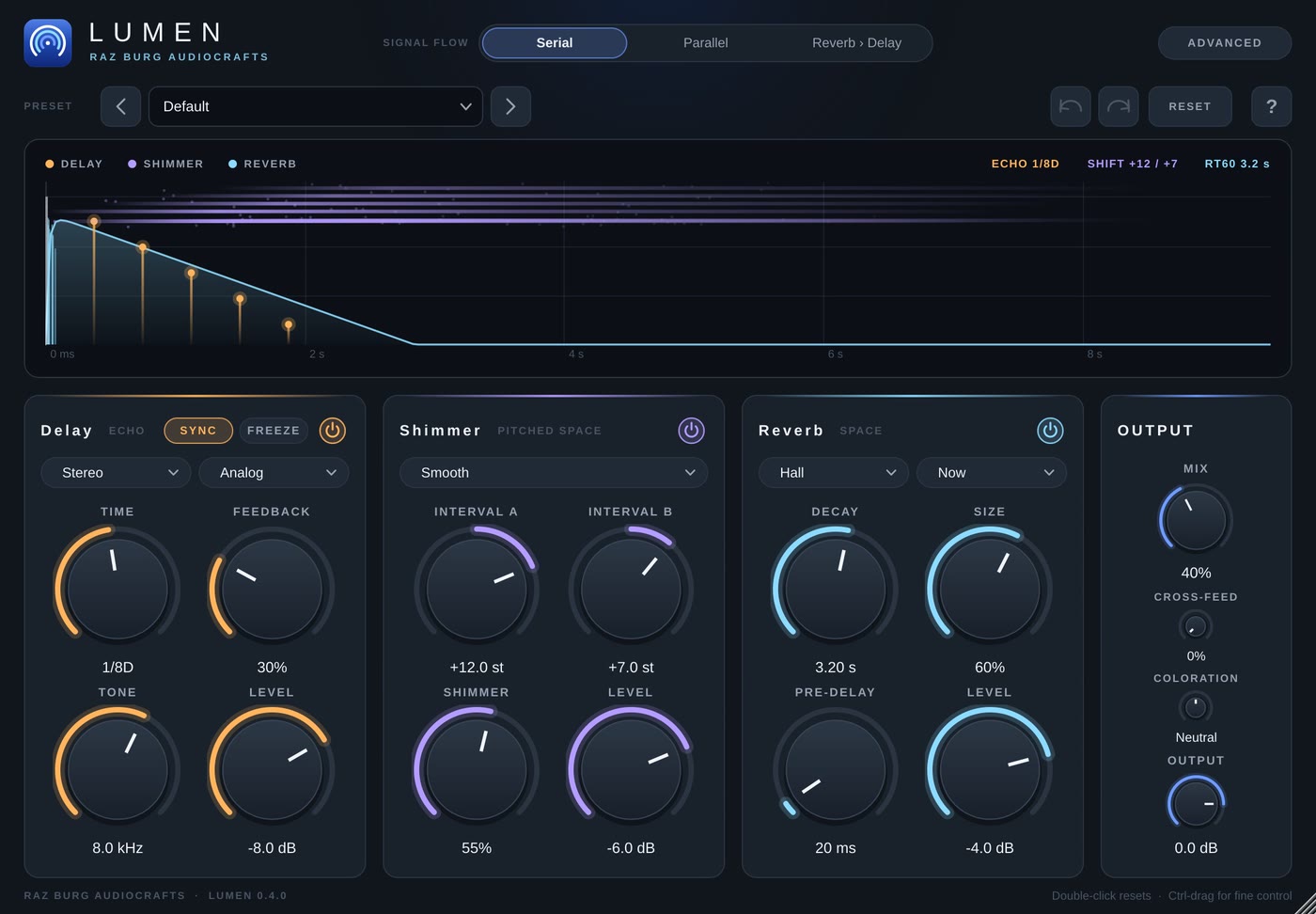
Three engines that play together.
Reverb, delay and shimmer each have their own section, and every one of them hides more than its knobs suggest.
A chamber you can stand in
In the 60s era, Chamber and Room become a modelled physical space: a half-tiled six-metre echo chamber and a smaller glass-walled room, with a speaker facing away from two microphones. The reflections come from the geometry, not from a pattern.
The drifting 90s hall
90s Hall and Cloud run on their own engine: one long ring of diffusers whose delays never stop moving, so no single resonance outlives the rest. Lows, mids and highs decay separately, and the bass rings on longest.
Shimmer that grows
The pitch shifters live inside the shimmer's own reverb loop. Each pass lifts part of the tail by your interval, so it climbs an octave at a time while the tank smears every step into a choir-like wash. Add a fifth on the second voice, or play each grain backwards for a soft, organ-like rise.
Echoes with a past
Clean, Analog, Tape and Lo-Fi are voiced inside the feedback path, so the character deepens with every repeat. Tape adds wow, flutter and a pitch glide when you change the time; Lo-Fi drops to about 11 kHz and 10 bits. Freeze holds the loop, ducking clears space while you play.
Coloration
One knob after everything. Shine generates 2nd and 3rd harmonics from the top octaves, so the tail gets brighter without simply getting more treble. Dark thickens the low mids and tilts the top away. At zero, it is not there.
Size without pitch bends
Resize the room in the middle of a tail and nothing warbles. The old tail rings out as it was, and new sound blooms in the new space.
Pick a room. Then pick a decade.
An era is not a filter on the output. It rebuilds the machine: what saturates inside the loop, how much bandwidth the tank has, how diffuse it is and how it moves. Every mode works in every era, and they are level-matched, so switching changes colour, not volume.
A tape send that saturates before the room, the soft top of tube microphones and a speaker's push in the mids. Chamber and Room turn into a real modelled chamber.
The darkest decade. Saturation inside the tank, heavy high damping and low diffusion: grainy, dense and warm, and darker still as it fades.
Early digital. The tail is sampled at 31.25 kHz into 12 bits, then smoothed by converter filters, for the glossy, faintly gritty sheen of the first rack reverbs.
Full bandwidth, rich diffusion and delays that drift at random. The low end outlasts the top. Hall and Cloud switch to the dedicated ring-hall engine.
Clean, precise, full-range space with nothing in the way.
Hall, Room and Chamber; Plate, dense and bright with no early reflections; Bloom, which swells in slowly; and Cloud, huge and drifting.
System and licence
Download the installers from My plugins after you sign in.
| Formats | AAX (Pro Tools), AU (Logic and other Mac hosts), VST3 (Cubase and other hosts) |
|---|---|
| Platforms | macOS and Windows |
| Licence | Free with your AudioCrafts account. Activate on up to 2 computers by signing in once from inside the plugin |
| Includes | Installers for every format, built-in user guide, updates |

Get Lumen. It’s free.
Create a free account, add Lumen to My plugins and download it for Mac or Windows.