Prism
Coming soon
Six EQs. The same controls.
Draw your curve once, then turn the mode and hear it through six different blends of classic consoles, program EQs and mastering desks. The bells change width, the shelves grow bumps and dips, the filters change their knee, and an analog stage waits behind the Drive knob. The controls never move. It opens flat and leaves your audio untouched until you touch something.
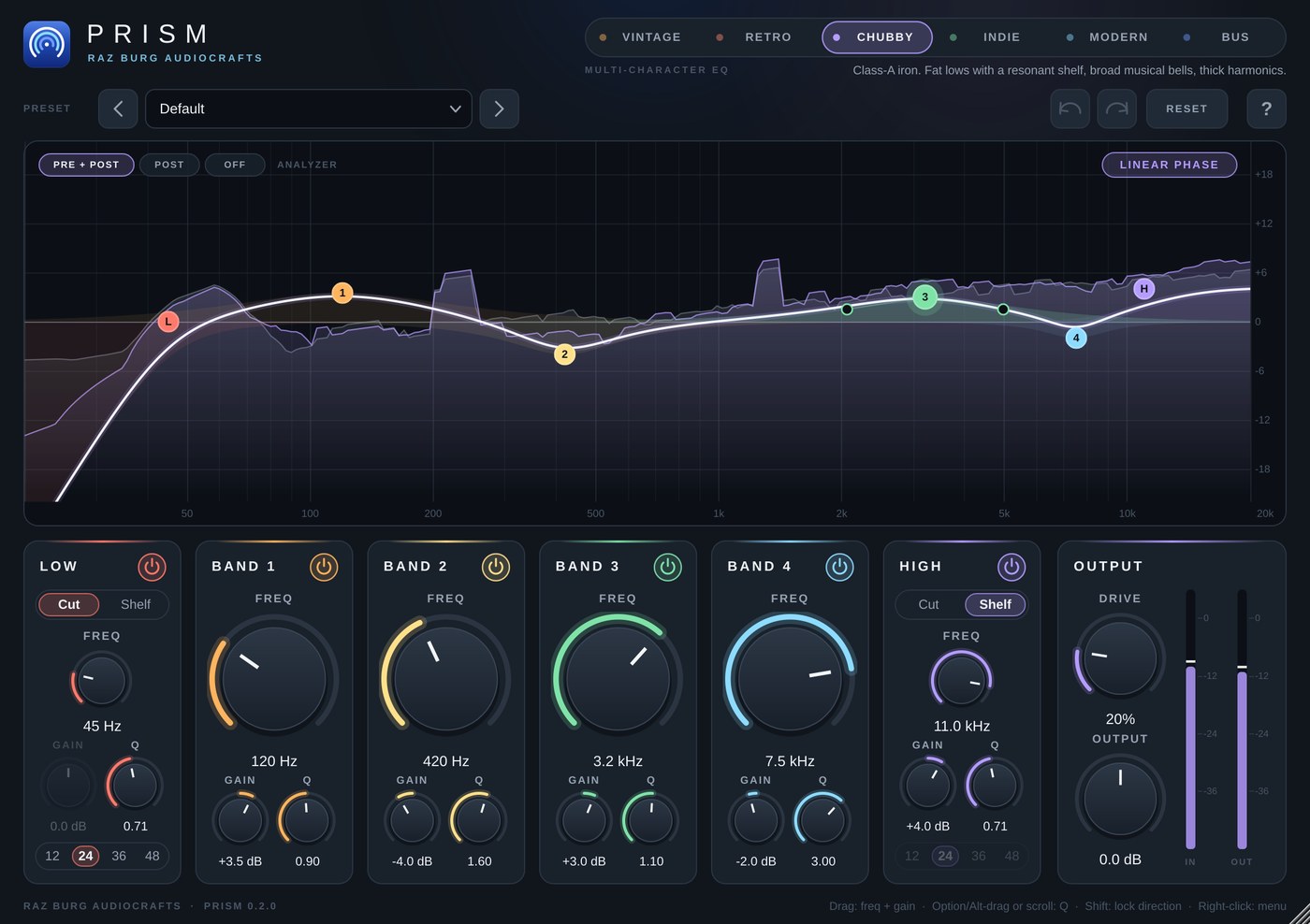
See what you hear. Hear it six ways.
A classic six-band layout with a display that shows exactly what the EQ is doing to your track, and lets you do everything right on it.
Bells that behave like circuits
In the console modes, a bell's width follows its gain: broad and forgiving for small moves, tighter as you push. Vintage cuts narrower than it boosts. Modern and Bus hold a constant Q for surgical work.
Shelves with a shape
Chubby and Indie shelves overshoot and dip around their corner, the way inductor and console circuits do. Vintage's low shelf pulls the low mids down as it boosts, the old boost-and-cut trick on a single knob. Bus stays perfectly smooth.
Drive
Push the analog stage of the selected mode: tube, console, transformer iron, grit, clean or mastering. Iron saturates the lows hardest, tube softens the top. At zero the path is completely clean.
Live spectrum
The source before the EQ in gray, the result after it in colour, with the curve drawn on top.
Everything on the graph
Drag a point, pull its width handles, scroll or Option-drag for Q, right-click for type and slope. The knobs are there when you want numbers.
Linear Phase
One switch removes all phase shift, for the mix bus, mastering and tracks that share a source. Off, Prism runs at zero latency.
One curve. Six voices.
The same names as Chroma’s characters, so the family sounds and feels the same. Each mode is its own blend; switch while the track plays.
A passive tube program EQ blended with a broad 70s parametric. The widest bells of the six, gentle shelves, a low boost that scoops the mud just above it, and tube warmth that rounds the top when driven.
A 70s American console's proportional bandwidth meets a British inductor-era desk. Bells start wide and narrow as you push, corners ring slightly, the top is silky.
British class-A inductor EQ through transformers, blended with a 60s studio desk. Broad bells, a resonant low shelf that bumps then dips, soft filter knees and the heaviest iron in the range.
A British large-format console blended with its 80s rival. Tighter bells, shelves that overshoot on both sides, and a gritty edge when you drive it.
Clean discrete class-A and transformerless design. Exact, open and airy, with almost nothing added.
A mastering chain: passive tube breadth, precise constant-Q parametrics, smooth air and shelves with no overshoot. Drive adds a subtle 2nd- and 3rd-harmonic glue.
System and licence
Prism is in final testing. It will appear in My plugins when it is released.
| Formats | AAX (Pro Tools), AU (Logic and other Mac hosts), VST3 (Cubase and other hosts) |
|---|---|
| Platforms | macOS and Windows |
| Licence | Free with your AudioCrafts account. Activate on up to 2 computers by signing in once from inside the plugin |
| Status | Coming soon |

Prism is coming soon.
Create a free account today. Lumen, Chroma and Convert are ready now, and Prism joins My plugins the day it is released.